

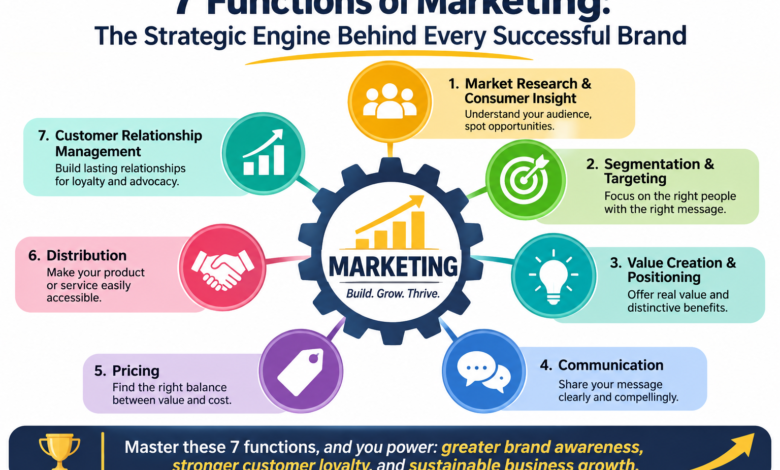
Marketing is often associated with advertising, social media campaigns, and sales promotions. However, successful 7 Functions of Marketing involves much more than attracting attention or convincing people to purchase a product. It includes understanding customers, developing valuable offerings, setting competitive prices, managing budgets, and making products accessible to the right audience.
The 7 functions of marketing provide a practical framework for understanding these activities. Each function has a different responsibility, but all seven work together to help businesses connect with customers, generate demand, and build sustainable growth.
Whether you manage a small business, work in digital marketing, or are developing a new brand, understanding these functions can help you see what happens behind every successful marketing strategy.
The 7 Functions of Marketing at a Glance
The 7 Functions of Marketing commonly taught functions of marketing are marketing information management, financing, pricing, promotion, product or service management, distribution, and selling.
| Marketing Function | Primary Purpose |
|---|---|
| Marketing Information Management | Understand customers, competitors, and market trends |
| Financing | Secure and manage resources for marketing activities |
| Pricing | Determine the value customers pay |
| Promotion | Create awareness and communicate product benefits |
| Product/Service Management | Develop and improve products or services |
| Distribution | Make products available to customers |
| Selling | Convert customer interest into purchases |
These functions are recognized in marketing education frameworks and are also discussed by business publications such as Brafton and Shopify. Their exact order may vary between educational resources, but the underlying responsibilities remain closely related.
What Are the 7 Functions of Marketing?
The 7 functions of marketing are the essential activities businesses perform to understand market demand, develop suitable products, communicate value, and complete exchanges with customers.
Marketing is not a single department activity that begins when an advertisement goes live. It involves decisions made before a product enters the market and continues through customer acquisition, delivery, and ongoing improvement.
The American Marketing Association’s definition of marketing emphasizes creating, communicating, delivering, and exchanging offerings that provide value. The seven-function framework helps break these broad responsibilities into more manageable business activities.
1. Marketing Information Management
Marketing information management involves collecting, organizing, analyzing, and interpreting information about customers, competitors, and the wider marketplace. It helps businesses understand what people need, how they make purchasing decisions, and which market opportunities deserve attention.
Companies can gather information through customer surveys, interviews, website analytics, sales records, social media discussions, and competitor research. These sources help marketers identify customer preferences, purchasing patterns, changing expectations, and potential gaps in the market.
For example, a skincare company may discover through customer reviews that buyers want fragrance-free products for sensitive skin. That information can influence product development, advertising messages, packaging decisions, and future pricing strategies.
Without reliable market information, businesses risk making decisions based on assumptions rather than actual customer behavior. Strong information management gives marketing teams a foundation for developing campaigns and measuring whether their decisions are producing meaningful results.
2. Financing
Financing is the function concerned with securing and managing the financial resources needed to support marketing and business activities. Even a promising marketing strategy requires money for product development, advertising, distribution, research, and other operating expenses.
Businesses must decide how much they can invest in marketing and where those resources should be allocated. This may include setting advertising budgets, paying suppliers, funding promotional campaigns, purchasing marketing technology, and planning for seasonal demand.
For example, a new clothing brand may need funds for inventory, product photography, influencer collaborations, paid advertising, and shipping. If the business spends too much on promotion without enough money to maintain stock, it may generate demand that it cannot fulfill.
Financing also involves evaluating the financial return of marketing activities. Companies should compare campaign costs with outcomes such as revenue, customer acquisition costs, and profit margins to understand whether their investments are supporting sustainable growth.
3. Pricing
Pricing determines how much customers pay for a product or service. It is a strategic marketing function because the price influences customer expectations, perceived quality, competitiveness, demand, and profitability.
Businesses consider several factors when setting prices, including production costs, operating expenses, competitor prices, customer willingness to pay, and the value their products provide. A price that is too high may discourage potential buyers, while a price that is too low can weaken profitability or create doubts about product quality.
For example, a premium skincare brand may charge more than a mass-market competitor because it offers specialized ingredients, distinctive packaging, or a stronger brand experience. However, customers must recognize enough value to justify the difference.
Pricing strategies can include cost-based pricing, value-based pricing, competitive pricing, introductory offers, and subscription models. The right approach depends on the target market, business objectives, and the position a brand wants to establish.
4. Promotion
Promotion involves communicating with potential customers to build awareness, explain product benefits, generate interest, and encourage purchasing decisions. It is the function most people associate with marketing because it includes visible activities such as advertising and social media campaigns.
Modern promotional strategies can involve search engine optimization, paid search advertising, social media marketing, email campaigns, public relations, influencer partnerships, content marketing, and traditional media. Each channel provides different opportunities to reach and engage a target audience.
For example, a local fitness studio might use Instagram videos to demonstrate workouts, Google Ads to reach people searching for nearby gyms, and email marketing to share membership offers. Combining suitable channels can help the business reach potential customers at different stages of their buying journey.
Effective promotion requires more than publishing frequent advertisements. Businesses need clear messaging, consistent branding, relevant offers, and measurable objectives. Campaign performance should be evaluated through indicators such as reach, engagement, qualified leads, conversions, and return on advertising spend.
5. Product and Service Management
Product and service management focuses on developing, maintaining, evaluating, and improving the products or services a business offers. The objective is to make sure that an offering continues to meet customer needs and remains competitive in its market.
This function can involve product research, feature development, quality control, packaging, branding, customer feedback, and decisions about product improvements. Marketing teams often work with designers, product developers, sales departments, and customer support teams to understand what customers expect.
Consider a company selling wireless headphones. Customer feedback may reveal that buyers want longer battery life, better noise cancellation, or more comfortable ear cushions. The company can use these insights to guide improvements and communicate the updated benefits to its audience.
Product management does not end after a successful launch. Customer expectations and competitors continue to change, so businesses must monitor product performance and identify opportunities to improve their offerings throughout their life cycle.
6. Distribution
Distribution ensures that products or services are available to customers through suitable channels. It involves deciding where customers can find an offering, how they can purchase it, and how it will reach them efficiently.
Businesses may distribute products through physical stores, company websites, online marketplaces, wholesalers, retailers, distributors, or delivery partners. Service-based businesses may use booking platforms, mobile applications, websites, or direct appointments to reach their customers.
For example, a coffee brand may sell through supermarkets, independent cafés, its own online store, and grocery delivery applications. Choosing the right combination of channels helps the company reach different customer groups while maintaining a consistent buying experience.
Distribution also requires coordination with inventory management, transportation, warehousing, and supply chain partners. A successful advertising campaign can create customer demand, but poor product availability or delayed delivery can damage the customer experience and weaken the brand’s reputation.
7. Selling
Selling is the function that turns customer interest into actual purchases. It involves understanding customer requirements, explaining product benefits, answering questions, handling objections, and helping buyers make informed decisions.
The selling process can happen through face-to-face conversations, telephone calls, online stores, sales representatives, live chat, and business-to-business presentations. Although the methods differ, the central objective is to match a customer’s needs with an appropriate product or service.
For example, a software company may attract potential customers through online advertising and educational content. Its sales team can then arrange product demonstrations, explain pricing options, address technical concerns, and help interested businesses choose a suitable subscription.
Successful selling is not simply about persuading someone to make a purchase. It also involves building trust, setting realistic expectations, and maintaining customer relationships after the transaction. Satisfied customers may return, recommend the business, and contribute to long-term revenue.
Why Are the 7 Functions of Marketing Important?
The seven functions help businesses understand marketing as a connected system rather than a collection of unrelated promotional activities. Each function supports a different part of the customer journey, from identifying a market opportunity to delivering a product and completing a sale.
They also help companies identify operational weaknesses. A business might have strong advertising but poor distribution, attractive products but unsuitable pricing, or enough customer demand but an ineffective sales process. Looking at all seven functions makes these gaps easier to recognize.
Another important benefit is better coordination between departments. Marketing, finance, product development, sales, and operations can use the same business objectives to guide their decisions, reducing the risk of disconnected strategies.
How the 7 Functions Work Together in a Real Business
Imagine a company preparing to launch a new line of organic skincare products. Its marketing information management team first researches customer preferences, competing brands, and demand for natural ingredients.
The company then uses those insights to develop suitable products, select packaging, and establish quality standards. Its pricing decisions consider production costs, competitor offers, and the value customers associate with the brand.
Financing supports the launch by providing resources for inventory, advertising, and distribution. Promotion introduces the products through social media, search advertising, email campaigns, and other relevant channels.
Distribution makes the products available through the company’s website and selected retail partners, while the selling function helps convert interested shoppers into paying customers. Customer feedback and sales data then provide information for improving the next product release.
This example shows why no single function can guarantee marketing success. Each activity contributes to the overall process, and weaknesses in one area can affect the performance of the others.
The Difference Between the 7 Functions of Marketing and the 7 Ps
The seven 7 Functions of Marketing and the seven Ps of marketing are related concepts, but they are not interchangeable. The seven functions describe important business activities involved in bringing products and services to customers.
The seven Ps represent a marketing mix framework used to plan how a business presents and delivers its offering. The traditional four Ps are Product, Price, Place, and Promotion, while the extended service-marketing model adds People, Process, and Physical Evidence.
| 7 Functions of Marketing | 7 Ps of Marketing |
|---|---|
| Marketing Information Management | Product |
| Financing | Price |
| Pricing | Place |
| Promotion | Promotion |
| Product/Service Management | People |
| Distribution | Process |
| Selling | Physical Evidence |
This table is a broad comparison of two different frameworks, not a direct one-to-one equivalence. For example, marketing information management supports decisions across several Ps, while selling is a wider activity that can involve people, processes, and promotional communication.
Understanding both models gives businesses a more complete view of marketing. The seven functions explain what marketing activities need to be managed, while the seven Ps help organize decisions about the overall customer offering and experience.
How to Apply the 7 Functions of Marketing to Your Business
Start by understanding your target audience and the problem your product or service is designed to solve. Use customer research, competitor analysis, and available business data to identify opportunities before committing significant resources.
Next, review the product itself, its pricing, and the financial resources required to bring it to market. Make sure your offer provides a clear benefit and that your pricing supports both customer expectations and business profitability.
Choose promotional channels based on where your audience spends time and how they research purchasing decisions. Your distribution strategy should make buying convenient, while your selling process should provide the information and support customers need to make a decision.
Finally, measure performance across all seven functions. Review customer feedback, sales figures, campaign results, distribution performance, and marketing expenses regularly. Use the findings to improve your strategy rather than treating marketing as a one-time activity.
Common Mistakes Businesses Make When Managing Marketing Functions
One common mistake is treating promotion as the entire marketing process. Businesses may spend heavily on advertisements without researching their audience, improving their product, or checking whether their distribution channels can handle increased demand.
Another problem is making pricing decisions without considering customer value, competitors, and actual operating costs. A low price may attract attention, but it does not automatically produce healthy profit margins or long-term customer loyalty.
Companies can also overlook the connection between sales and marketing. When promotional messages create expectations that the sales team or product cannot fulfill, customers may lose trust. Coordination, consistent communication, and regular performance reviews help prevent these problems.
The Future of Marketing Functions in a Digital Business Environment
Digital technology has changed how companies perform many traditional marketing activities. Customer research can now involve website analytics and social listening, while promotion can reach audiences through search engines, social platforms, email, and connected advertising systems.
Artificial intelligence and automation are also influencing how businesses analyze information, generate content, organize customer data, and manage routine workflows. These tools can improve efficiency, but they still require accurate information, clear objectives, and human oversight.
The underlying functions remain relevant even as the tools evolve. Businesses still need to understand customers, develop useful offerings, manage financial resources, set prices, communicate value, distribute products, and support purchasing decisions.
Brands that combine these fundamentals with responsible use of modern technology can build more coordinated marketing strategies. The goal is not simply to use more tools, but to create a better experience for customers while supporting sustainable business performance.
Conclusion
The 7 Functions of Marketing provide a practical foundation for understanding how successful brands operate. From researching customer needs and developing products to setting prices, promoting offers, managing distribution, and completing sales, each function contributes to the overall marketing process.
Businesses that manage these activities together can make better decisions, respond to customer expectations, and use their resources more effectively. Marketing success is not simply about being visible; it is about delivering the right value to the right people through a coordinated strategy.
As markets and technologies continue to evolve, these seven functions remain useful principles for building brands, improving customer experiences, and supporting sustainable growth.
FAQ’s
What are the 7 Functions of Marketing?
The 7 Functions of Marketing commonly taught functions are marketing information management, financing, pricing, promotion, product or service management, distribution, and selling. Together, they help businesses understand customers, develop offerings, communicate value, and complete sales.
Why are the 7 Functions of Marketing important?
They help businesses organize marketing responsibilities, identify weaknesses, coordinate different departments, and make informed decisions. Each function contributes to delivering value and supporting long-term business growth.
Which marketing function involves advertising?
Promotion is the marketing function most directly associated with advertising. It also includes public relations, content marketing, social media, email campaigns, influencer partnerships, and other activities used to communicate with potential customers.
What is the difference between marketing and selling?
Marketing is the broader process of understanding customer needs, developing offerings, communicating value, and making products available. Selling is one part of that process, focused on helping customers make purchases and generating revenue.
What is marketing information management?
Marketing information management is the process of collecting, organizing, analyzing, and using information about customers, competitors, and market conditions. It helps businesses make decisions based on evidence rather than assumptions.
Are the 7 Functions of Marketing the same as the seven Ps?
No. The seven functions describe activities such as research, financing, pricing, promotion, product management, distribution, and selling. The seven Ps are a marketing mix framework consisting of Product, Price, Place, Promotion, People, Process, and Physical Evidence.
Can small businesses use the 7 Functions of Marketing?
Yes. Small businesses can apply all seven functions even when they do not have separate marketing departments. The same person may manage customer research, pricing, promotion, sales, and distribution, but each responsibility still needs attention.
Which function of marketing is the most important?
No single function can guarantee success on its own. Their importance depends on the business, product, market conditions, and customer needs. A strong marketing strategy requires coordination across all seven functions.

One Comment